
Research Essentials
Online Information Literacy Course | Canvas LMS
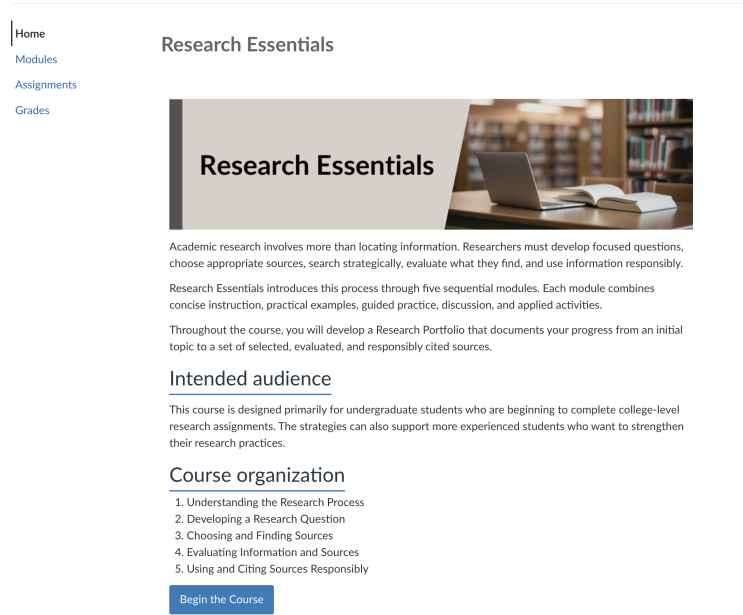
Research Essentials is a five-module online information literacy course designed to guide undergraduate students through the research process. Learners progressively apply research skills as they build a Research Portfolio across the course.
- Audience: Undergraduate students beginning college-level research
- Role: Instructional designer, developer, subject matter expert
- Tools: Canvas LMS, Adobe Premiere Pro, PowerPoint, Audacity
- Scope: Five-module course architecture with Module 3 fully developed as a representative prototype
Design Challenge
Beginning researchers are often expected to locate and use academic sources without receiving coherent instruction in how the stages of research fit together. The course needed to transform several related information literacy skills into a structured process that learners could apply to an authentic research project.
Design Approach
I used backward design to structure the course around the culminating Research Portfolio, an authentic assessment that learners build incrementally across the five modules. I mapped the components of the portfolio to course and module outcomes, then aligned instruction, practice activities, and assessments with the skills learners would need to complete each component successfully.
Rather than presenting research skills as isolated topics, I organized the course as a scaffolded process in which work completed in one module supports the next. Learners move from interpreting an assignment and developing a research question to choosing and finding sources, evaluating and integrating information, and citing sources responsibly.
I designed the complete five-module course architecture and fully developed Module 3, Choosing and Finding Sources, as a representative prototype. Within the module, instruction progresses from activating learners’ prior work and introducing source selection and search strategies to modeling, guided practice and feedback, and application through a Research Portfolio assignment.
Research Essentials | Canvas Course
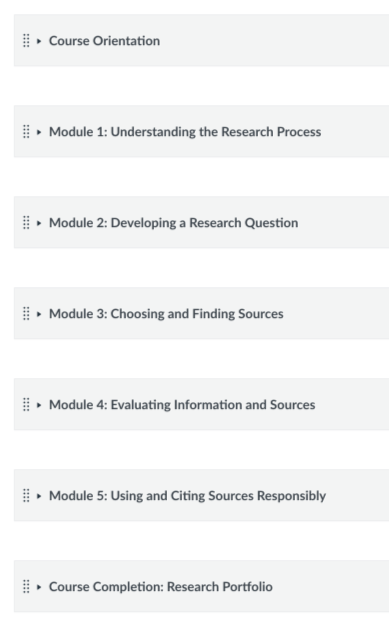
Research Essentials is a five-module online information literacy course designed for undergraduate students. The course guides learners through the research process—from interpreting an assignment and developing a focused research question to finding, evaluating, integrating, and citing sources. Students build a Research Portfolio through scaffolded assignments completed across the course.
I developed the complete course architecture in Canvas and fully developed Module 3, Choosing and Finding Sources, as a representative module. The prototype demonstrates course organization, instructional sequencing, guided practice, multimedia integration, authentic assessment, accessibility, and Canvas configuration.
Research Essentials | Canvas Course
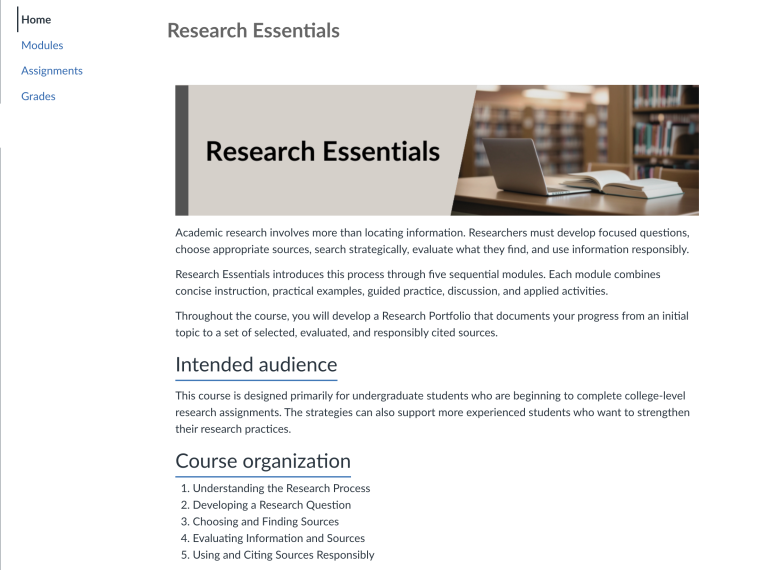
Research Essentials is a five-module online information literacy course designed for undergraduate students. The course guides learners through the research process—from interpreting an assignment and developing a focused research question to finding, evaluating, integrating, and citing sources. Students build a Research Portfolio through scaffolded assignments completed across the course.
I developed the complete course architecture in Canvas and fully developed Module 3, Choosing and Finding Sources, as a representative module. The prototype demonstrates course organization, instructional sequencing, guided practice, multimedia integration, authentic assessment, accessibility, and Canvas configuration.
Design Approach
I used backward design within an iterative, ADDIE-informed process. Beginning with the culminating Research Portfolio, I mapped its components to the five course modules and aligned each module’s objectives, instruction, practice, and assessments with those components. Module 3 follows a Gagné-informed sequence: it activates the research question developed in Module 2, presents and models source-selection and search strategies, provides guided practice and feedback, and culminates in an applied assignment.
Video Tutorials
I used Adobe Premiere Pro to produce video tutorials for the Canvas course. This example demonstrates how to use OneSearch, an integrated discovery tool on the library website, to locate and use print and electronic books about arts administration topics.
To build these multimedia assets, I also used QuickTime for screen capture, Audacity for audio recording and editing, and PowerPoint for presentation graphics.
